
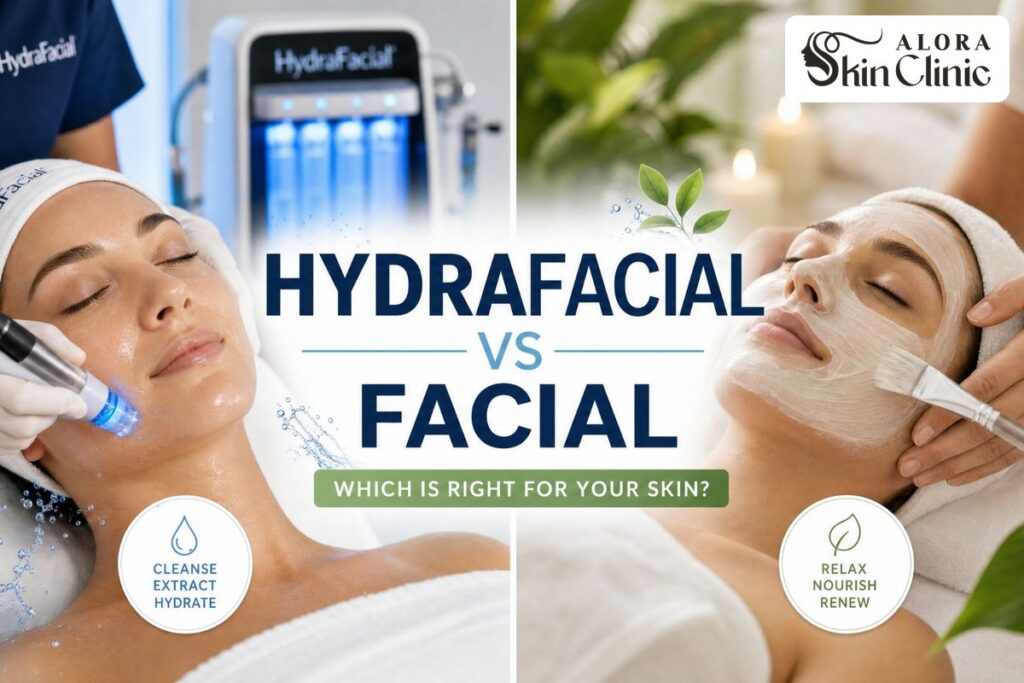
If you have looked at Alora’s treatment menu and landed on the same question a lot of people do, “should I book a regular facial or spend a bit more on a HydraFacial,” this is the honest answer. They are not the same treatment, they are not trying to do the same job, and the right one depends entirely on what you want your skin to do and by when.
Here is how to tell which is for you, without the marketing gloss.
The real difference in one line
A regular facial is largely done by hand. A HydraFacial is done by a device.
That sounds small, but it is the whole story. A classic facial relies on a skilled aesthetician cleansing, steaming, massaging and treating your skin with products. A HydraFacial uses a vortex suction tip that cleanses and extracts while it delivers serums into the skin at the same time. One is a hands-on treatment that feels wonderful. The other is a machine-driven treatment built for a consistent, visible result. Neither is better in the abstract. They are just built for different goals.
What a regular facial is really for
A classic facial is a maintenance and wellbeing treatment. It cleanses, it usually includes steam and gentle exfoliation, some manual extractions, a massage and a mask, finished with products chosen for your skin. It leaves you calm, cared for and a bit brighter.
That is exactly what a lot of people want, and it is why our classic facial starts from $89, the most accessible treatment on our menu. If your skin is generally healthy and you want to keep it that way, unwind for an hour, and have your skin cleaned and looked after by an expert, a regular facial is the right call and the better value. Booking one every four to six weeks keeps most skin ticking along nicely.
What a classic facial is not built to do is force a dramatic, camera-ready change in a single session. It supports your skin. It does not resurface it.

What a HydraFacial is really for
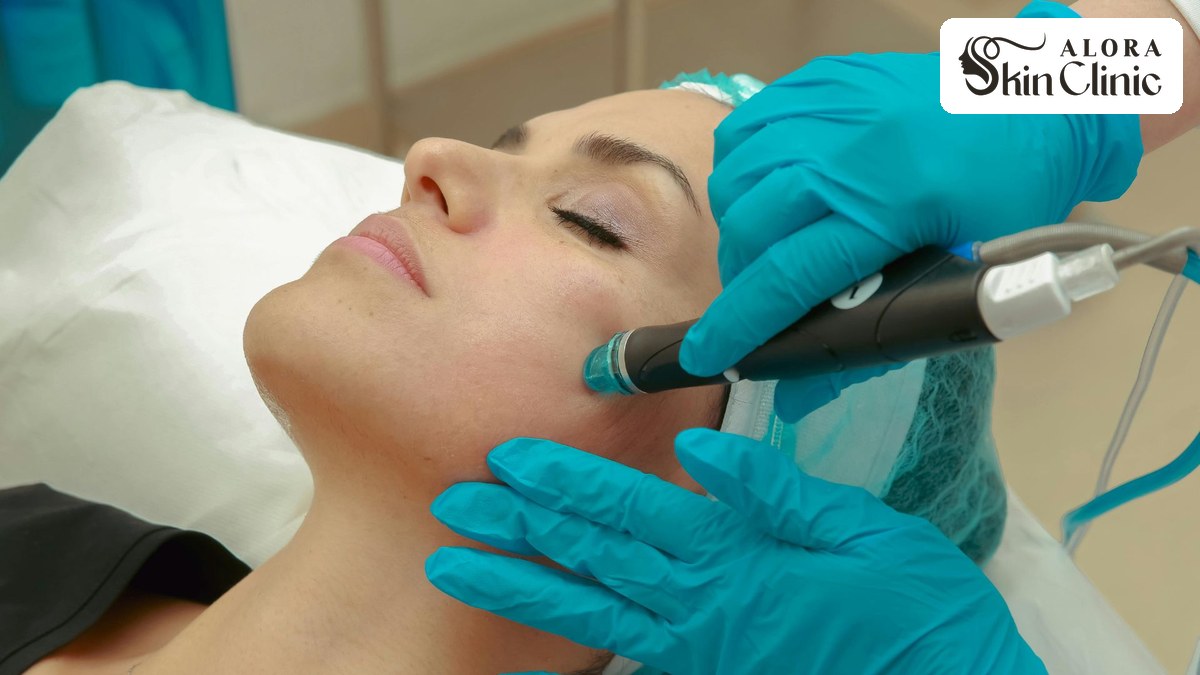
A HydraFacial is a resurfacing and hydrating treatment. In one pass it cleanses and exfoliates, runs a gentle glycolic and salicylic acid peel to loosen debris in the pores (part of why it can soften the look of enlarged pores), lifts out blackheads and congestion with suction rather than fingers, then floods the skin with antioxidants and hyaluronic acid. There is an optional LED step for concerns like acne or redness.
The reason people pay more for it, $139 at Alora versus $89 for a classic facial, is that the device does more in the same appointment: it both deep-cleans and hydrates, and it does it more consistently than hands can. The result is visible quickly, which is why HydraFacials are the treatment people book before a wedding, a shoot or an event. If your skin is dull, congested, dehydrated or breakout-prone, and you want it to visibly change rather than simply feel pampered, this is the one.
The honest caveat is longevity. The immediate glow lasts around five to seven days, and the deeper hydration and clarity hold for roughly four weeks. One session buys you a genuinely good week. Changing how your skin behaves over time comes from a series, not a single visit.
Which one should you book?
Strip away the names and it comes down to your goal.
Book a regular facial if you mainly want to relax and maintain healthy skin, you are on a tighter budget, or your skin has no specific complaint you are trying to fix. It is the better value when relaxation is the point.
Book a HydraFacial if your skin looks dull, tired or congested, you struggle with blackheads and clogged pores, you have an event coming up and want to look your best on a specific date, or you simply want a more visible result than a classic facial gives. You are paying the extra for extraction and hydration in one session, and for a clearer outcome.
And book neither, yet if what actually bothers you is acne scarring, deep texture, or pigmentation. Those are not facial problems. As we say plainly on our HydraFacial page, a HydraFacial will not do what a course of microneedling or laser does. A facial of either kind makes your skin look and feel better now. It does not remodel it. If that is your goal, ask about the right treatment instead of paying for the wrong one.
Where they sit on price
We publish our prices so you can decide before you call. Here is the full facial ladder, so you can see exactly where each option sits:
- Classic Facial, from $89
- Oxygen Therapy, from $99
- Microdermabrasion, from $99
- Anti-Aging Facial, from $109
- Anti-Acne Facial, from $119
- HydraFacial, from $139
- Microneedling, from $300
A HydraFacial sits at the upper end of the facials and well below the advanced treatments. Final pricing depends on the area treated and any add-ons, and we confirm it with you before we begin, never after. The full list is on our price list.
Who should wait or avoid either treatment
This matters more for a HydraFacial, because it exfoliates and uses active serums, but it is worth knowing before you book.
A HydraFacial is not suitable if you have an active skin infection or you are pregnant, since some of the serum actives are avoided in pregnancy. You should wait ten to fourteen days after Botox, dermal filler or a laser treatment, so the skin is not disturbed while it settles. It is not appropriate if you have taken isotretinoin, known as Accutane, in the past twelve months, because the skin stays fragile long after. Tell us first about any allergies, particularly to salicylic acid, glycolic acid or shellfish, since some serums contain shellfish-derived ingredients. And if you have rosacea or skin that flushes easily, speak to us before booking, because exfoliation combined with suction can trigger a flare. A gentle classic facial is often the safer choice for reactive skin, and we can adjust from there.
We screen for all of this at your consultation, before anything is booked.
Frequently asked questions
Is a HydraFacial just a fancy facial?
Not quite. A regular facial is largely manual and more relaxing. A HydraFacial is device-driven and more consistent in its result, especially for congestion and hydration. They overlap in that both clean the skin, but they are built for different goals.
Does a HydraFacial hurt more than a facial?
No. Most people find it relaxing. The extraction step uses suction rather than manual squeezing, so it is generally more comfortable than the extractions in a traditional facial.
Is the HydraFacial worth the extra money?
If your goal is a visible refresh before an event, or you deal with congestion and dullness, yes, the extra buys you a clearer, more consistent result. If your goal is simply to relax and maintain, the classic facial is better value. There is no wrong answer, only the right one for your goal.
How often should I get either one?
Every four to six weeks suits most people for both. With a HydraFacial, if you have congestion or frequent breakouts, every two to three weeks at first can help bring things under control before you space them out.
Can I switch between them?
Yes. Many people book a classic facial for regular maintenance and a HydraFacial before an event or when their skin needs a reset. They complement each other.
Neither is fixing my acne scars or pigmentation. Why?
Because those need a treatment that works deeper than a facial. Come in and we will point you to the right option rather than sell you repeat facials that were never going to get there.
Book the right one in Scarborough
If you are still not sure which suits your skin, that is exactly what a consultation is for. Come in, and we will look at your skin, tell you honestly whether a classic facial or a HydraFacial fits your goal and your budget, and say so if the cheaper one is the better choice for you.
Call (647) 547-0597 or book a consultation at Alora Skin Clinic, inside Pharmasave at 21 Glendinning Ave, Scarborough. Want the full breakdown first? Here is everything on our HydraFacial in Scarborough page.
New to facials? Start with whether facials are good for your skin and what they actually do.