
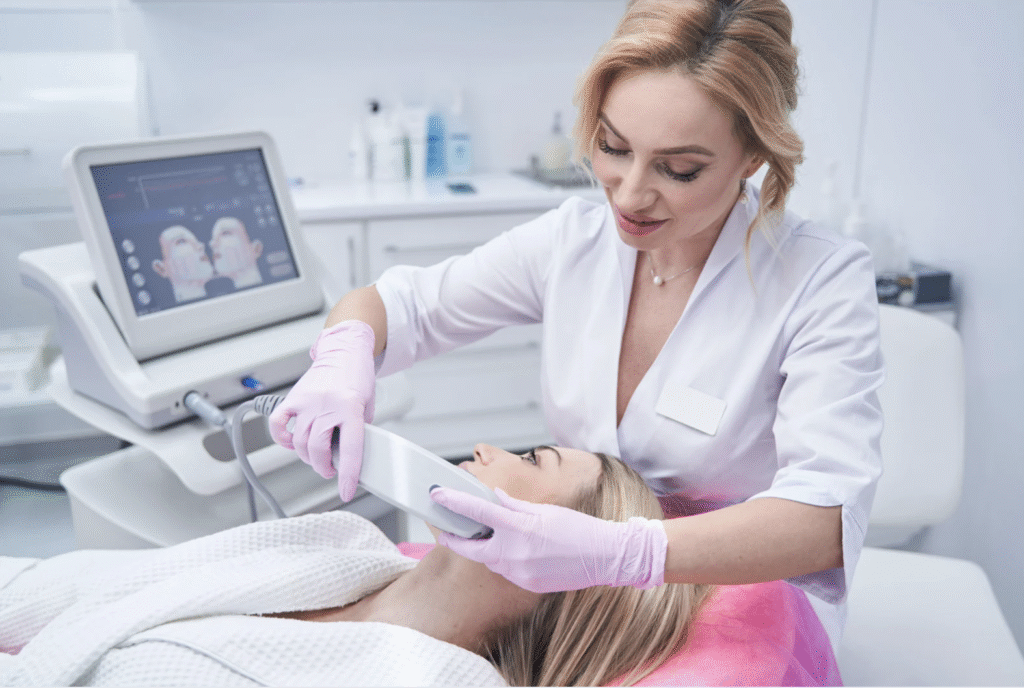
If you have started to notice your jawline softening, a little looseness under the chin, or skin that does not sit quite as firmly as it used to, you have probably come across two very different answers: a surgical facelift, or a non-surgical treatment called HIFU.
They are not the same thing, and the honest truth is that one is not simply better than the other. They solve different versions of the same problem, and the right choice depends on how much laxity you have and what you actually want. Here is a straight comparison, without the hype.
What each one actually does
A facelift is surgery. A surgeon lifts and repositions the deeper tissue, tightens the underlying muscle layer, and removes excess skin. Because it physically removes and re-drapes skin, it produces a dramatic, long-lasting change, and it is the right tool when there is significant sagging or loose skin that has gone past what the skin can do on its own.
HIFU, which stands for High-Intensity Focused Ultrasound, takes a completely different route to a similar goal. Instead of cutting or removing anything, it delivers focused ultrasound energy deep into the skin, down to the same foundational support layer that a surgeon addresses in a facelift. That energy gently heats tiny points in that deep layer, and your body responds by contracting existing collagen straight away and then producing fresh collagen over the following weeks and months. The result is a gradual lift and tightening from within, with no incisions, no injections, and no downtime.
So the simplest way to put it: a facelift removes and repositions tissue surgically. HIFU prompts your own skin to rebuild and tighten itself.
Results: how much, and how long
This is where being honest matters most.
A facelift produces the bigger, more obvious change, and it lasts the longest. Surgical results are typically measured in many years, often a decade or more, because the underlying structure has been physically altered.
HIFU produces a more subtle, natural improvement, and it works gradually. Most people see visible firming and lift develop over roughly two to three months as the new collagen builds, and studies show the large majority of people do notice an improvement. Those results generally last in the region of 12 to 18 months, after which natural aging slowly catches up, so many people have a maintenance session about once a year to hold onto the effect.
If you are picturing HIFU as a needle-free version of a facelift that gives you the exact same result, that is the one expectation worth resetting. It does not lift as much, and it does not last as long. What it does do is improve firmness and definition meaningfully, look natural rather than “done,” and ask nothing of you in terms of recovery.
Downtime, risk, and cost
The trade-off is really about what you are willing to go through.
A facelift involves anesthesia, surgical risk, and a genuine recovery period of a couple of weeks or more of swelling, bruising, and healing before you look presentable, and longer before the final result settles. It also costs considerably more.
HIFU asks for none of that. There is no anesthesia, no surgery, and no recovery. Most people walk out and go straight back to their day. Some mild redness or a little tenderness afterward is the usual extent of it. It is a far smaller commitment in every sense, which is exactly why it appeals to people who are not ready for surgery, or who do not need it yet.
Which one is right for you?
It really comes down to how much laxity you are dealing with.
HIFU tends to be the better fit if you have mild to moderate skin laxity, an early softening of the jawline, some looseness on the neck, a heaviness to the brow, or crepey skin on the chest, and you want a natural improvement without surgery or downtime. It is also a sensible option if you are trying to stay ahead of aging and maintain firmness over time rather than reverse advanced sagging.
A facelift tends to be the better fit if you have significant sagging or a lot of excess, loose skin, and you want the most dramatic, longest-lasting correction available, and you are prepared for surgery and recovery to get it.
There is also a middle path a lot of people do not realize exists: HIFU can be a way to postpone more invasive treatment, keeping your skin firmer for longer so that surgery, if you ever choose it, comes later rather than sooner.
At Alora Skin Clinic, HIFU treats the jawline, the neck and chin, the brow, general facial firmness and fine lines, and the décolletage. It also pairs well with other non-surgical treatments like microneedling when your goal is overall skin quality alongside firmness. If you are weighing those two specifically, we compare HIFU and microneedling in their own guide.
What honest guidance looks like
The most important part of this decision is an honest assessment of your skin, not a sales pitch for whichever treatment a clinic happens to offer.
Every HIFU treatment at Alora begins with exactly that: Naz assesses your skin laxity, listens to what is bothering you and what you are hoping for, and tells you honestly whether HIFU is likely to give you the result you want. If your laxity is genuinely beyond what a non-surgical treatment can address, the right answer is to say so, rather than to sell you a series of sessions that were never going to be enough.
If HIFU is a good fit, the session itself is straightforward: a consultation and skin assessment, careful mapping of the treatment zones for even coverage, and then the focused ultrasound treatment itself, all with no downtime afterward.
Book a HIFU consultation at Alora Skin Clinic in Scarborough, and you will get a straight answer about what HIFU can realistically do for your skin.
General information, not medical advice. A consultation is needed to assess your skin and confirm whether HIFU is suitable for you.
Frequently asked questions
Is HIFU as good as a facelift?
No, and any honest clinic will tell you that. A facelift gives a bigger, longer-lasting result and can remove excess skin, which HIFU cannot do. HIFU gives a more subtle, natural firming with no surgery and no downtime. They suit different degrees of laxity, which is why an assessment matters.
When will I see HIFU results, and how long do they last?
The lift builds gradually as your skin produces new collagen, so most people see the improvement develop over about two to three months. Results generally last in the range of 12 to 18 months, and many people have a maintenance session roughly once a year.
Is HIFU painful, and is there any downtime?
Most people tolerate it well, feeling warmth and occasional deeper prickles during treatment. There is no real downtime. Some mild redness or tenderness afterward is normal and settles quickly, and you can return to your day right away.
Who is a good candidate for HIFU?
People with mild to moderate skin laxity, an early softening jawline, a loosening neck, a heavy brow, or crepey chest skin, who want a natural result without surgery. If you have significant sagging or a lot of loose skin, a surgical option may serve you better, and we will tell you that.
What areas can HIFU treat?
At Alora, HIFU is used on the jawline, the neck and chin, the brow, overall facial firmness and fine lines, and the décolletage.